
One person, One Identity
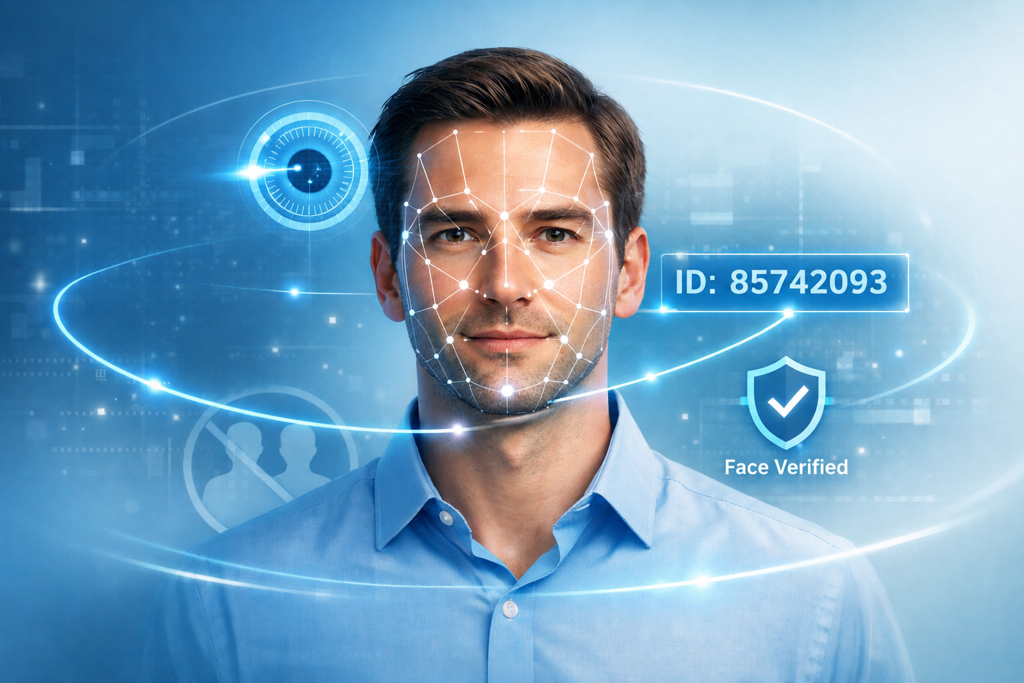
When you cross a border, does your identity follow?
A new country. A new life. But who are you to the authorities?
In today's increasingly mobile world, people move across borders to work, study, and build new lives. When they do, they often need a national identity number to access essential services like employment, taxation, healthcare, and housing. This raises a critical question for authorities:
Does this person already have an identity number in the system, or do they need a new one? Are they actually who they say they are?
These two questions might sound simple. However, for governments and identity authorities, they represent two distinct and serious challenges, each with real consequences if handled incorrectly.
The Challenge
Problem one: identity number issuance
The first problem is about records. When someone applies for an identity number, the system needs to check: has this person already been issued one? Maybe they lived in Norway briefly years ago and received a D-number. Maybe their name was recorded differently. Maybe they appear in the system under a maiden name or a spelling variation.
Without a reliable way to check, the same person can end up with multiple identity records a fragmented digital identity that causes headaches for the person and opens the door to abuse.
Documents alone cannot solve this. A name can change. A passport can be renewed. A face, however, stays consistent across decades. Biometric face matching against existing records is one of the most reliable ways to detect whether someone has already been registered, regardless of what name or document they present.
Problem two: identity proofing
The second problem is deeper. Even if the system establishes that a person does not yet have a record, it still needs to answer a harder question: are they genuinely the person they claim to be?
This is identity proofing: the process of verifying that the real, living person standing in front of you or logging in from their phone actually corresponds to the identity they are presenting. A forged passport, a borrowed identity document, or a stolen set of credentials can all pass a basic document check. Identity proofing adds a biometric layer to catch what documents cannot.
Use case
Consider a concrete example. A skilled software engineer moves from Stockholm to Oslo to start a new job. She is qualified, tax-paying, and ready to contribute. Before she can open a bank account, sign a lease, or access healthcare, Norwegian authorities must must verify the following: that she has no existing Norwegian identity number, and that she is genuinely who her passport says she is. Both steps matter. Skipping either creates identity fraud risk.
How Mobai helps
Mobai provides biometric identity verification technologies that can help tackle these two challenges. Our solutions integrate with existing identity management systems and support both de-duplication and identity proofing for both nationals and foreign nationals.
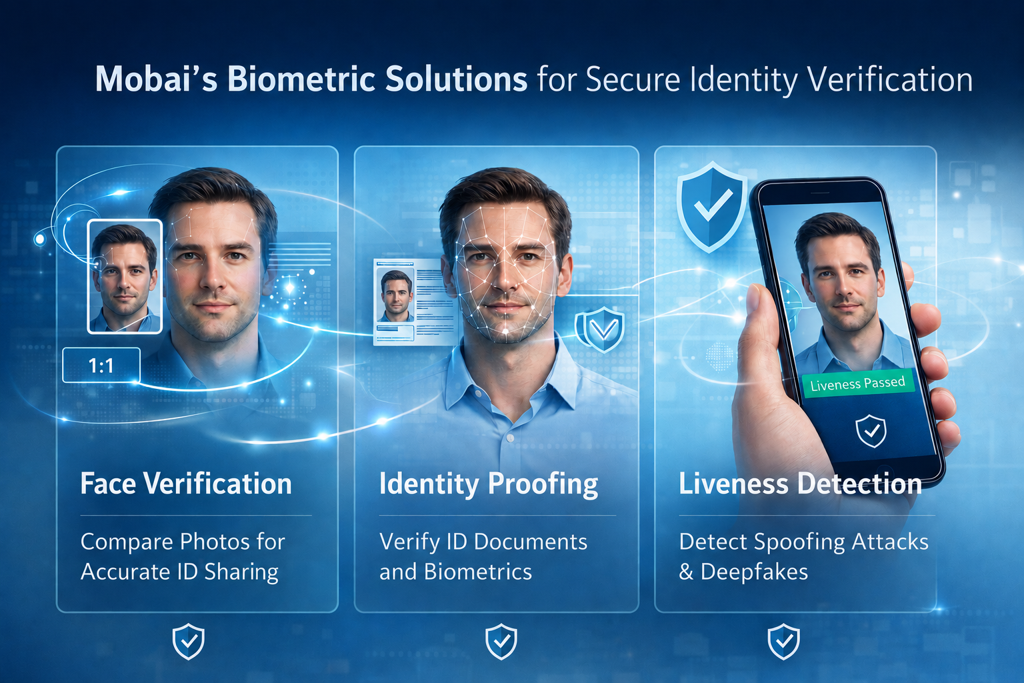
Face verification confirming identity across records
Mobai's face verification technology compares facial images to determine whether two images belong to the same individual.
Our algorithms have been evaluated by the National Institute of Standards and Technology (NIST) and are trusted by European banks and government institutions. It is a biometric anchor that persists even when names, documents, or life circumstances change.
Read more: https://www.mobai.bio/products/face-verification
Identity proofing verifies the person, not just the paper
Mobai's identity proofing solution verifies who someone is during onboarding remotely, on-the-fly or in person by combining ID document validation, and biometric checks. The result is a verified identity at assurance levels recognised under eIDAS: either Substantial, which is fully self-serviced and remote, or High, when the highest level of trust is required.
This is particularly important for foreign nationals who arrive without an existing Norwegian or EU eID. For this group, there is no pre-existing digital identity to fall back on. Mobai's solution can establish a verified identity from the ground up and that verified identity can be upgraded to a higher assurance level once a Norwegian or EU eID is eventually assigned.
Read more: https://www.mobai.bio/products/id-proofing
Liveness detection ensuring a real person is present
Mobai's liveness detection ensures that the face presented during verification belongs to a real, live person. Our solution aligns with ISO/IEC 30107-3, the international standard for biometric presentation attack detection.
Read more: https://www.mobai.bio/products/liveness-detection
What Mobai is already doing
These are not just concepts. Mobai is actively working on these problems in production, in government contracts, and in collaborative research.
The Digdir contract: biometrics at the heart of Norwegian eID
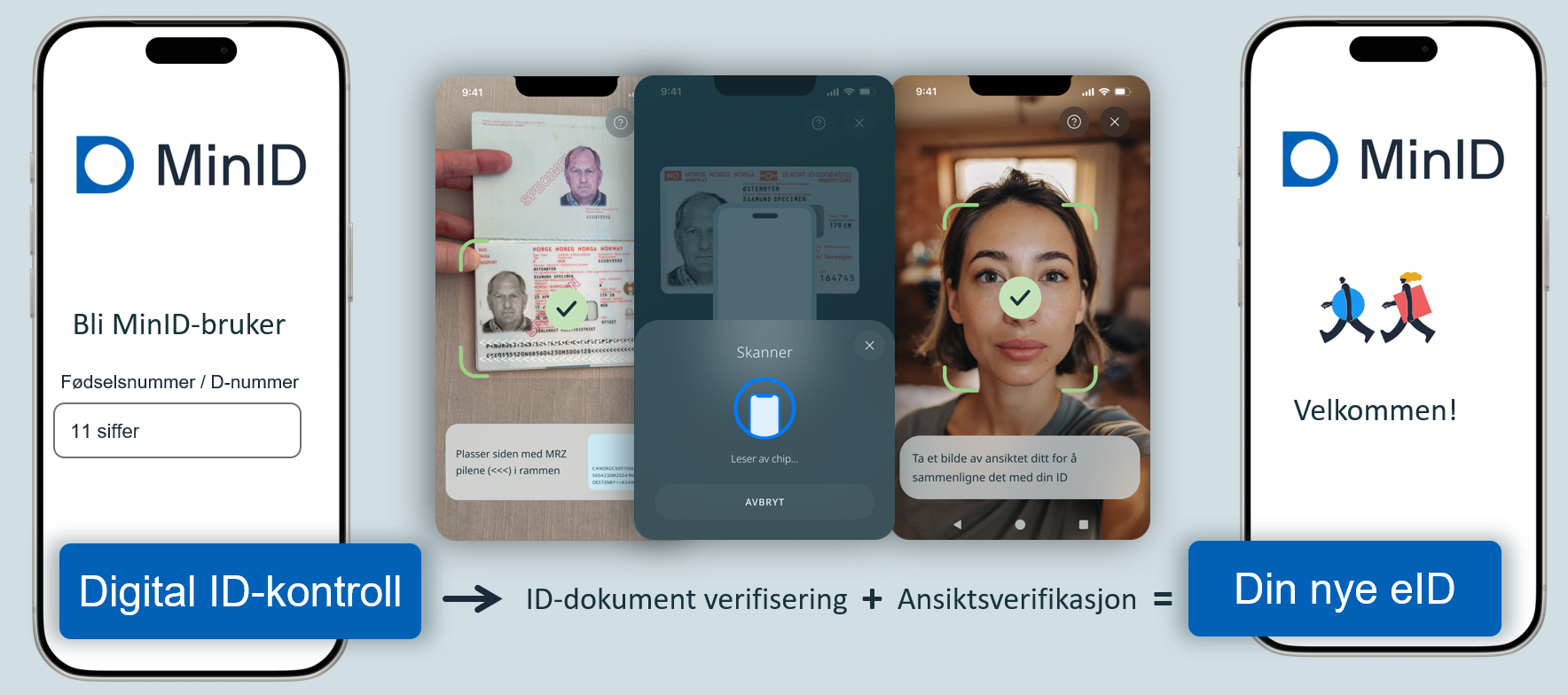
In 2025, Digdir, the Norwegian Digitalisation Agency awarded its Digital ID-kontroll contract to a partnership between Commfides Norge AS and Mobai. Digdir operates ID-porten, the national eID gateway used by essentially every adult in Norway, and MinID, the eID Norwegians use daily to access tax records, healthcare appointments, and public services.
The Digital ID-kontroll solution places Mobai's facial biometrics at the core of how Norwegian citizens are verified when registering for a government eID. It combines document verification with face matching to confirm, at the moment of registration, that the person creating an account is genuinely present and genuinely themselves.
Importantly, the contract also includes an option for eID issuance for foreign nationals. Under this provision, Digital ID-kontroll could be used for identity verification when issuing a new Norwegian eID to foreign nationals, offered as a shared solution for the public sector and managed by Digdir. This directly addresses the scenario of people arriving in Norway without an existing Norwegian or EU digital identity.
Read more: https://www.mobai.bio/post/norway-picks-european-biometrics-at-the-heart-of-government-identity
EINSTEIN: European-scale identity and document fraud detection
At the European level, Mobai is a partner in EINSTEIN. An EU Horizon Europe project running from 2024 to 2026, funded with approximately 6.3 million euros. EINSTEIN develops an interoperable suite of applications to enhance European identity and document security and fraud detection across member states.
The project addresses the reality that identity fraud is not a national problem. It is a cross-border one. A fraudulent identity created in one country can be used in another. EINSTEIN works toward shared tools and standards that let European authorities detect and prevent this, supporting both the integrity of national identity systems and the emerging European Digital Identity Wallet framework under eIDAS 2.0.
Project details: http://cordis.europa.eu/project/id/101121280
User-controlled shareable biometrics: the privacy-first future
Looking further ahead, Mobai is part of a research project exploring what cross-border biometric identity could look like when individuals are in control. The "User-controlled shareable biometrics" project, supported by the Norwegian Research Council with 12 million NOK in funding, is being carried out together with partners Simula UiB and KU Leuven.
The project asks a fundamental question: how can a person carry a verified biometric identity across borders securely, privately, under their own control while fully complying with GDPR, eIDAS 2.0, and the EU AI Act? The goal is not a central biometric database, but a system where the individual holds and shares their own verified identity, on their own terms.
Summary
As people move more freely across borders, two identity challenges become increasingly important: ensuring that identity records are correctly managed across systems, and ensuring that every person who enters an identity system is genuinely who they claim to be.
Biometrics and specifically face verification, identity proofing, and liveness detection are the most reliable tools available for both challenges. A face cannot be borrowed. It does not change with a passport renewal and it can be verified remotely, privately, and at scale.
Mobai is already helping governments and organisations solve these problems: through the Digdir Digital ID-kontroll contract, through the EU-funded EINSTEIN research project, and through our ongoing research into privacy-preserving cross-border identity.
The goal is simple: One person. One identity.
Curious to learn more? Let's talk!
We'd love to hear from you! Reach out and let's discuss how we can work together.
Frequently Asked Questions
What services does Mobai provide?
Mobai provides advanced identity verification and biometric authentication solutions designed to enhance security and streamline authentication and digital onboarding processes. Our services include AI-driven face verification, remote and physical ID document authentication, and liveness detection to prevent spoofing attempts. We also offer compliance solutions for KYC (Know Your Customer) regulations, ensuring businesses can verify identities securely and meet legal requirements. Additionally, Mobai provides easy-to-integrate APIs and SDKs, allowing companies to incorporate identity verification seamlessly into their existing platforms, whether for financial services, fintech, or other industries requiring secure user authentication.
How do I create an account on Mobai?
Feel free to contact us if you want a person to give you an introduction or learn more about our solutions. To create an account with Mobai, simply press the Get started button on our website to sign up. Once registered, you can integrate and test our solution for free, allowing you to explore its capabilities and evaluate its effectiveness. When you're ready to move to production, you'll need to contact our sales team to discuss your specific requirements and complete the onboarding process.
What programming languages and frameworks does Mobai support?
Mobai supports multiple programming languages and frameworks to ensure seamless integration across various platforms. For mobile applications, we provide SDKs for iOS (Swift), Android (Kotlin) and React Native, enabling developers to integrate identity verification into native apps efficiently. Our solutions are designed to be flexible and developer-friendly, making it easy to integrate Mobai's identity verification technology into your existing applications. For detailed implementation guidelines, refer to our API documentation or contact our support team.
Does Mobai offer a trial period for free?
Yes, we offer a free trial period for businesses looking to test our services. The trial includes access to our key features so you can evaluate the effectiveness of our identity verification solutions. Click the "Get started" button to try it out.
How do I get in touch with Mobai's customer support?
You can reach out to our customer support team by sending an email to info@mobai.bio, and we'll be happy to assist you with any questions or issues.